Range Hood Repair
There Is No Attic: Venting a Wolf Hood in Krisana Park's 1954 Post-and-Beam Houses
In a Krisana Park post-and-beam house the ceiling you see is the roof deck, so there is no attic, no joist bay and no chase for a Wolf hood duct — which leaves exposed spiral along the beam line, a curbed roof penetration, or recirculation, each with its own service life.
Written by
Desmond Achebe
Cooking-appliance technician — controls and fault codes · 11 years in the trade
Reads the stored history before clearing anything. An oven that locks itself once a fortnight will not reproduce on demand, and the board already wrote down when it did.
Krisana Park sits inside Virginia Village, bounded by Florida Avenue to the south, South Dahlia Street to the west, Louisiana Avenue to the north and Fairfax and Filbert to the east: about 175 Eichler-inspired houses designed by Frenchie Gratts and built by H.B. Wolff and Co. in 1954-55 on what had been an alfalfa field. Post-and-beam construction, exposed tongue-and-groove ceilings, clerestory windows, low-slope rooflines, most of them around 1,200 square feet. The ceiling you are looking up at is the roof deck. There is no attic.
The part of the year that matters
Two moments in the calendar expose a hood duct in a house like this. The first hard cook of the cold season tests whether the duct still moves air. The first real thaw afterwards tests whether the hole it passes through is still watertight. They arrive within a few months of each other, and between them they account for most of the calls we take from Virginia Village.
Cold air pouring down the duct while the hood is off is a winter symptom and a specific one: a backdraft damper that is no longer seating. Meltwater on a low-slope roof is patient and it is unforgiving of details — the curb and jack around a duct penetration is the first thing it finds. The stain then appears on a tongue-and-groove board, which is not a ceiling that can be patched invisibly.
What the swing asks of the machine
A backdraft damper has to do two contradictory things. It has to seal against a pressure difference that only exists when it is cold outside, and it has to swing open against a blower starting under load. Grease stiffens as temperatures drop, the flap sticks, and the motor spends its first seconds pushing on a closed door. Do that for a season and the wear shows up as a start that is slower every time.
The house asks something too. A small footprint with clerestory glazing and no attic buffer means a hood at full speed can measurably depressurise the room, so what the appliance draws and what the room can replace stop matching. And where a previous owner gave up on ducting altogether and converted to recirculation — which happens often here, for the obvious reason — the hood has become a filter appliance. Charcoal condition decides whether it works, and the blower’s health is almost beside the point.
The failure it produces, and when
The complaints arrive in a fairly fixed order across a season.
Capture falls first: smoke rolls out into the room even on the top setting. Then the blower starts strong and falls back to a whine, which is a wheel loaded with grease or a motor labouring against a restricted run rather than a motor that has failed. Then the lights buzz and dim as the fan speeds up, which is a supply and driver problem and not a lamp problem.
Underneath all three sits the routing decision somebody made during the remodel, and each option has its own service life. Exposed spiral duct running along the beam line puts every joint and every grease deposit in plain view and demands a real cleanout regime, but it is honest and inspectable. A straight penetration through the low-slope membrane with a curb and jack is the shortest run and becomes the roof’s most leak-prone detail, so it is the first thing to check when a ceiling board stains. Recirculation avoids both and trades them for a cartridge schedule.
One practical consequence: a technician who arrives at a Krisana Park kitchen expecting to find ductwork above the ceiling has wasted the visit. Tell us the house type when you book. Post-and-beam also means the wall behind the appliance may be non-bearing infill or full-height glazing, which changes what can be cut and where a hood can be hung at all.
Getting ahead of it
Put the baffles through the dishwasher on a schedule rather than when they start to smell. Before the cold sets in, go outside and look at the termination: does the damper swing freely by hand, is the screen clogged, is the curb flashing intact and is the sealant still flexible. That is a ten-minute job that prevents the two most common winter calls.
If your run is exposed spiral, wipe the seams and look at what comes off. A weeping seam is a joint that has been leaking grease for some time and will keep doing it. If yours recirculates, replace charcoal on a date rather than on a symptom. And in spring, look at the ceiling boards around any roof penetration while the light is low and raking, which is when a stain shows first.
What we do on the visit
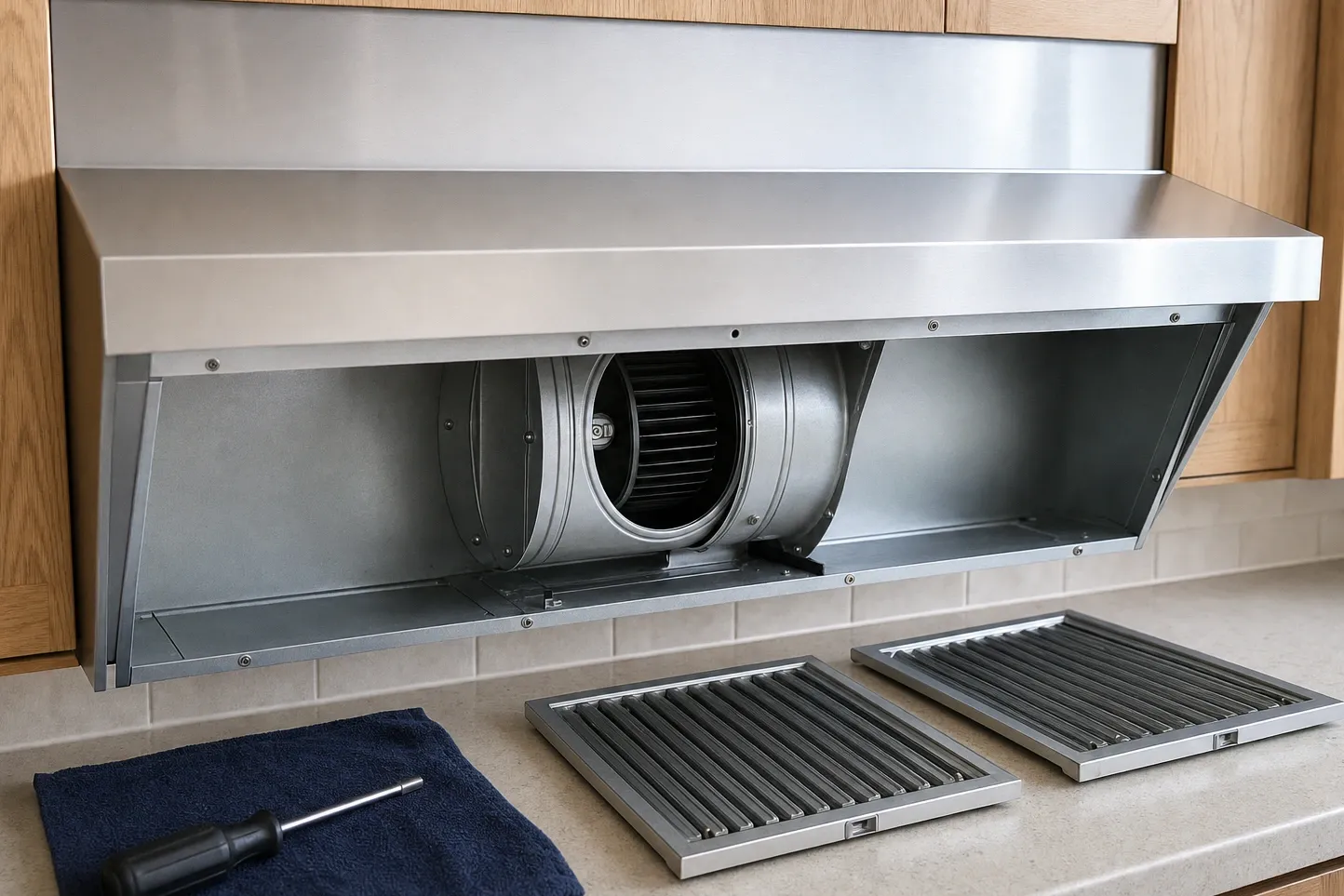
The order is deliberate. We run every speed and note precisely which ones do what, because missing speeds and weak speeds mean different things. We pull the baffles and spin the wheel by hand while it is cold, feeling for grease loading and bearing play. We meter at the blower and at the control, since a hood sharing a circuit with other kitchen equipment can simply be short of voltage. Lighting and drivers come next. Only then do we look at the route — because in a Krisana Park house the route is the diagnosis, not a footnote to it.
The diagnostic is 89 dollars. Where a component is at fault, the bands here are 270 to 690 dollars for a convection fan or motor, 420 to 870 dollars for a control board or touch panel, 180 to 470 dollars for an igniter or spark module, 240 to 580 dollars for burner valve or orifice service, 180 to 470 dollars for oven thermostat or sensor calibration, and 300 to 660 dollars for door hinge, glass or seal work.
Elsewhere in the city the same duct question wears different clothes: long shared runs above the slab in Golden Triangle lofts, century-old service behind brand-new equipment in Five Points, and island ventilation in the larger Belcaro houses off Bonnie Brae. The method does not change. (303) 801-0060 reaches the same technician who would take the call.
Follow-up questions
There is no attic in my Krisana Park house. Where can a hood duct actually go?
Three routes exist. An exposed spiral duct along the beam line, which is inspectable and cleanable but visible. A straight penetration through the low-slope roof with a proper curb and jack, which is the shortest run and the detail most likely to leak later. Or a recirculating conversion, which removes the routing problem entirely and replaces it with a charcoal cartridge schedule you have to actually keep.
Cold air blows down through my hood all winter. Is that normal?
No, and it is fixable. It means the backdraft damper at the termination is not seating — usually because grease has stiffened on the flap, a hinge has corroded, or debris is holding it open. In a house with no attic buffer above the ceiling you feel it immediately. Check the damper by hand from outside before the cold sets in; it is the single most common winter complaint we take here.
Water stained my tongue-and-groove ceiling near the hood. Is the appliance at fault?
Almost never the appliance. On a low-slope roof the curb and flashing around a duct penetration is the most leak-prone detail on the whole assembly, and meltwater finds it first. Because the ceiling is the roof deck, the stain lands on exposed boards that cannot be patched invisibly, so it is worth addressing early. That work belongs to a roofer; we will identify the penetration and document it.