Range Repair
Wolf burner clicks and will not light: the mile-high checklist
A Wolf gas burner that ticks and never catches is usually a cap out of position, a wet or cracked igniter, or an orifice set for the wrong elevation. What to check yourself in ten minutes, and what needs a manometer.
Written by
Desmond Achebe
Cooking-appliance technician — controls and fault codes · 11 years in the trade
Reads the stored history before clearing anything. An oven that locks itself once a fortnight will not reproduce on demand, and the board already wrote down when it did.
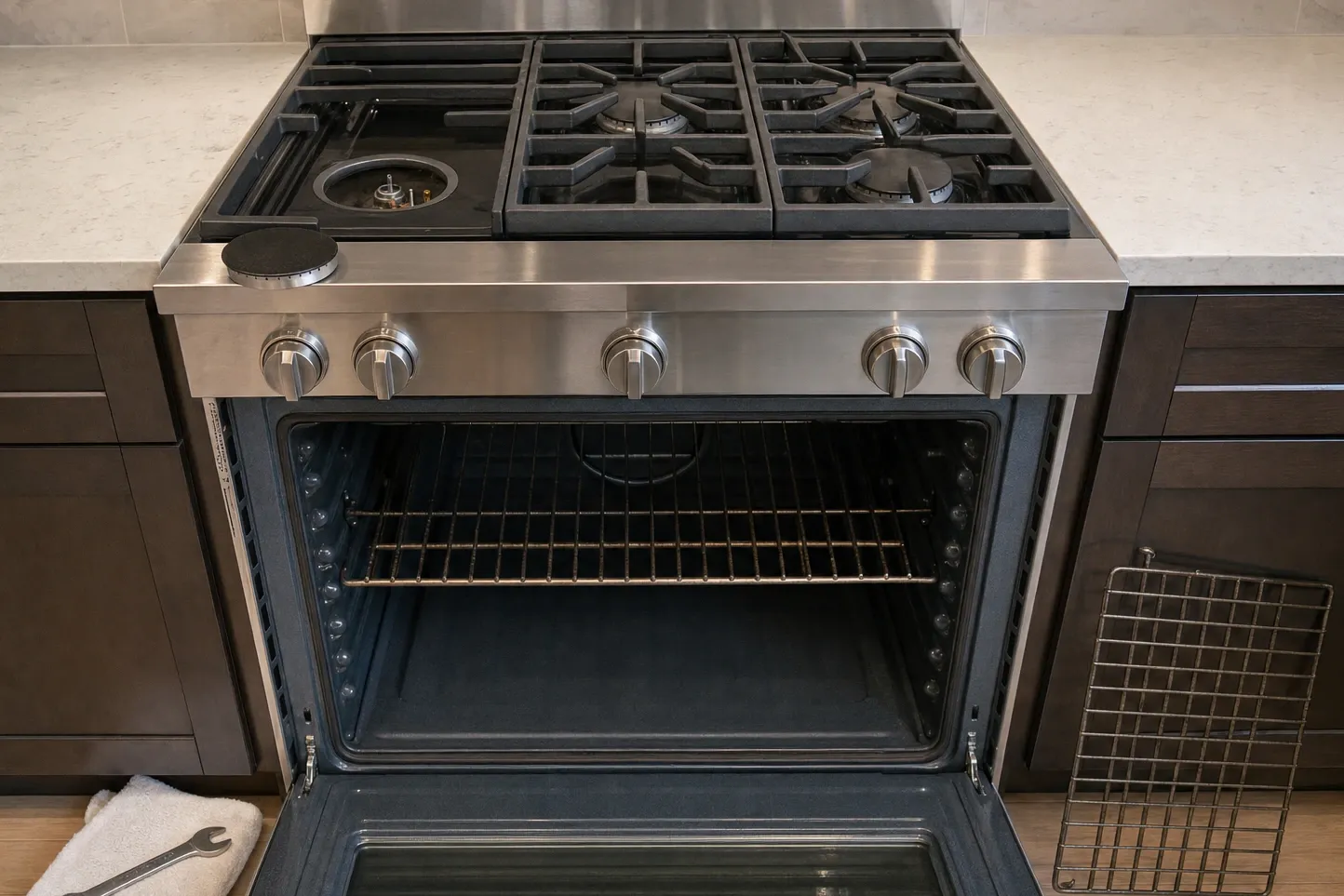
A Wolf burner that ticks steadily and never catches is rarely the dramatic fault it sounds like. In Denver kitchens it comes down to four things, and two of them you can rule out yourself in ten minutes without touching a tool. Work through them in order, because the cheap causes are also the common ones.
Start with the cap, because it is free
Lift the grate and take the burner cap off the head. Look at how it was sitting: the cap has a locating step and it must drop flat, square and fully home. A cap set down a couple of millimetres off centre shrouds the flame ports nearest the electrode, and the spark then has nothing to ignite even though gas is flowing.
While the cap is off, look at the ports themselves. A ring of ports blocked by dried boil-over will light on one side and not the other, or light late with a pop as the flame travels around. A stiff brush and a straightened paperclip clear them; never drill them out, because a widened port changes the flame shape permanently.
Set the cap back on, feel it seat, and try again. A surprising share of calls end here, and we would rather you found it than paid someone to find it.
Then the igniter, and what a wet one looks like
Wolf sealed burners spark from a ceramic electrode sitting beside the burner head. Two things stop it working. Moisture is the first — after a big spill, a clean, or a pot that boiled over, the ceramic holds water and the spark tracks down the wet surface instead of jumping the gap. That version fixes itself: leave the burner off, dry the area, and give it a couple of hours.
The second is a crack in the ceramic, and this is the one that behaves oddly. A cracked electrode still sparks, so the clicking continues, but the spark now jumps to the nearest metal rather than across the gap where the gas is. You get confident ticking and no flame, and it is often worse on a cold morning because the crack opens slightly as the range warms and closes as it cools.
Look at the electrode in good light for a hairline through the white ceramic, and for a spark that visibly lands on the burner base instead of the gap. Compare the sound with a burner that works: a healthy spark is a sharp, even snap, while a leaking one is a duller, faster rattle.
When every burner is weak, look upstream
If one burner misbehaves, suspect that burner. If all of them light lazily, roar and lift off their caps, or refuse to hold a simmer, the problem is upstream and altitude becomes relevant.
Air at 5,280 feet is roughly seventeen percent thinner than at sea level. The same orifice passes the same gas but has less oxygen to burn it with, so the mixture runs rich. Rich looks like this: yellow tips instead of a clean blue cone, soot on the bottom of a kettle, a flame that lifts away from the cap and roars, and a simmer that either goes out or will not come down.
The usual culprit is not the elevation itself — it is a conversion done wrongly. An orifice set left over from an LP installation, or a high-altitude kit fitted from the wrong parts list, is very common in a city where ranges get moved and resold. The other upstream possibility is supply pressure: a regulator that has drifted, or in older Curtis Park and Five Points housing, a service line that simply does not deliver the pressure a modern range expects.
Both need a manometer to prove, and that is where do-it-yourself stops being useful. Measuring pressure at the appliance and at the meter takes a technician ten minutes, and the readings either point back inside the range or hand you a written number to give the utility.
The griddle and the simmer burner, which fail differently
Two extras worth knowing. If your range has an integrated griddle, uneven browning front to back is not the plate warping — it is one of the burners under it starved of gas or set with a low flame that is too low. It is adjusted, not replaced.
And a burner that lights fine on high but drops out at the lowest setting has a low flame set below what this altitude will sustain. That adjustment is a screw inside the valve stem, reachable with the knob off, and it needs setting warm rather than cold — a simmer tuned on a cold range often quits once everything is up to temperature.
What to have ready when you do call
By the time you have checked the cap, cleared the ports, dried and inspected the electrode and noticed whether one burner or all of them are affected, you have already done the useful half of the diagnosis. Say which of those you tried and what changed.
Have the model number to hand — the plate is usually behind the kick panel or under the cooktop lip — and mention whether the range has ever been moved or converted, because that single fact often points straight at the orifices. If a burner will not shut off, or you can smell gas with everything switched off, that is the one version of this fault that should not wait: shut the gas off at the appliance valve, ventilate, and call.
Follow-up questions
Is it safe to keep trying a burner that clicks without lighting?
A few attempts, with the room ventilated, is normal troubleshooting. Do not stand there cycling it for minutes on end — unburnt gas is collecting while you do, and a delayed light is what produces the small bang people describe. If you can smell gas at all, turn the knob off, open a window, leave it for several minutes, and if the smell persists leave the house and call the utility before anyone else.
Do Wolf ranges need converting for Denver altitude?
Wolf equipment is rated to work across a wide altitude range, and many units need no parts changed at all. What causes trouble here is a unit that was converted wrongly — an LP orifice set left in after a move, or a high-altitude kit fitted by guesswork. That shows up as flame lift, soot, or a simmer that will not hold, and it is fixed by matching the orifices to the model and the fuel and then setting the low flame properly.
Why does only one burner misbehave when they all share the same gas line?
Because each burner has its own orifice, its own electrode and its own path to the spark module, and the front burners collect far more boil-over than the back ones. A single misbehaving burner points at that burner. All burners weak or lifting at once points upstream — regulator, meter pressure, or a shared conversion done wrong.